

The windows in your Toronto home do a lot of heavy lifting. They let in natural light, keep out cold winter drafts, and connect you to the outside world. Adding the right draperies to them gives you even more control over your living space.
Well-sized and chosen draperies cut glare, keep your space private at night, and bring a cozy, finished look that hard blinds can’t match. When you choose them thoughtfully, draperies for windows balance practical everyday needs with your home’s style.
This guide will walk you through everything you need to know about choosing the right draperies for your Toronto home, including fabrics, light control, styles, and budgeting.
Let’s get started.
How Do You Choose the Right Draperies for Your Toronto Home?
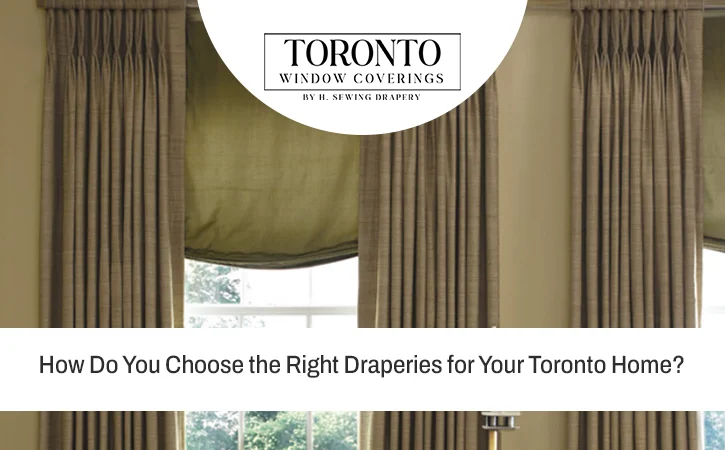
To find the best option, start with your window dimensions and light control preferences. You can then look at fabric weight, lining options, pleat styles, and your overall budget, including hardware and installation costs. Focusing on these details ensures your window coverings fit properly and work well in your space. You are best off consulting with drapery professionals like us to help make the right choices.
Making these decisions at the start of the drapery-buying process helps you avoid the extra cost of replacing panels later. A panel that is too narrow will hang flat instead of full and graceful. A thin lining in a bedroom might let in unwanted morning light. The following sections walk through each step so you can make informed choices during your consultation.
What Are the Different Types of Draperies for Windows?
Window draperies come in four main varieties: sheer, room-darkening, blackout, and decorative.
Each type manages light and privacy differently. Sheer panels soften daylight without blocking it out completely. Room-darkening draperies cut out most incoming light. Blackout options block light almost entirely. Decorative panels focus more on fabric texture and style than functional light control. The best option for your home depends on how you use each room.
When comparing your options, it helps to look at how much light each fabric lets through. Understanding these categories makes it much easier to choose the right fit before visiting a showroom.
Sheer draperies diffuse natural light while providing daytime privacy. They soften bright sunlight without making your space feel dark. Homeowners often use sheers as a base layer, pairing them with thicker panels that can be closed at night for full privacy.
Room-darkening draperies block out most incoming daylight. While a small amount of light may still glow around the edges, the room stays significantly darker. They work well in bedrooms, nurseries, and home offices where you want a dark space without complete blackout conditions.
Blackout draperies feature specialized linings to block nearly all light. They are a great choice for night shift workers, baby rooms, and media spaces where screen glare is a problem.
Decorative draperies focus on pattern, weave, and visual appeal. They are popular in dining rooms and formal spaces where window coverings serve mainly as a design feature rather than a practical light filter.
| Type | Light Control | Privacy | Best Room |
| Sheer | Minimal — softens without blocking | Good by day, limited at night | Living rooms, sunrooms, layering |
| Room-Darkening | Strong — blocks most light | Good day and night | Bedrooms, nurseries, home offices |
| Blackout | Maximum — blocks nearly all light through fabric | Full; day and night | Shift-worker bedrooms, media rooms |
| Decorative | Low to moderate; depends on fabric weight | Moderate | Dining rooms, formal sitting areas |
Which Drapery Fabrics Work Best for Toronto Homes?
Toronto experiences cold winters and warm, humid summers, making linen, cotton, polyester blends, and velvet practical choices for window treatments. The material you pick determines how the fabric drapes, how long it lasts, how well it insulates, and how easy it is to clean. Choosing the right one comes down to how you use the room and what you need from your treatments each day.
Here is a quick look at the strengths and trade-offs for each fabric:
Linen
- Creates a relaxed, textured look that fits modern and transitional homes
- Lightweight and breathable, making it a great option for living rooms and casual spaces
- Wrinkles easily, so adding a lining helps give it shape and body
- Lets in light when unlined, so it may not work well in spaces where you need daytime privacy
Cotton
- Offers a crisp, clean appearance and holds dye well so colours stay vibrant
- Versatile enough to suit bedrooms, dining spaces, and family rooms
- Can shrink in hot water, so always review the care instructions before cleaning
- Blending cotton with polyester offers the same classic look with better resistance to wrinkles and fading.
Polyester Blends
- A practical choice for everyday use that keeps its shape, resists wrinkles, and cleans easily
- Ideal for busy spaces where panels get opened and closed often
- Has less texture than natural fibres, giving it a smooth and uniform look
- Most machine washable options rely on synthetic blends
Velvet
- Adds weight and warmth, making it ideal for bedrooms and formal areas where draft control matters
- Blocks light effectively and works well with blackout linings for maximum darkness
- Needs sturdy hardware to support the extra weight over time
- Usually requires dry cleaning since water can ruin the texture
What Drapery Styles Should You Consider?
Three popular drapery choices for homes in the area include box pleats, French pleats, and grommets. Each brings a unique look to a room, ranging from tailored and classic to clean and modern. Options like tab top, rod pocket, and wave fold are also available depending on your setup.
These styles can be custom tailored to fit your specific window dimensions. This ensures the folds look balanced and full from top to bottom, creating a polished finish you rarely get with off-the-shelf options.
Box Pleat
Box pleats feature flat, structured folds sewn across the top of the drapery. The pleat lies flat against the fabric to create a clean silhouette. This style fits well in traditional and transitional spaces. When opened, the panels stack tightly to leave plenty of glass exposed during the day.
French Pleat (Pinch Pleat)
French pleats are a timeless choice for custom window coverings. Groups of fabric are pinched together near the top, allowing deep folds to fan outward. The result is a graceful panel that drapes evenly. They hang easily from rings or tracks and adapt well to both classic and modern rooms.
Grommet
Grommet styles feature metal rings set directly into the fabric, allowing the curtain rod to thread through easily. This creates soft waves across the top. It is a practical option that slides open smoothly, making it ideal for windows you open and close often.
Other Styles
Tab top panels use simple fabric loops for a relaxed feel. Rod pockets slide straight onto the rod, which creates a gathered look that works best for stationary panels. Wave folds run on a continuous track to form consistent curves, offering a sleek look for full-height glass walls.
Custom Draperies vs. Ready-Made Draperies: Which Should You Choose?
Custom draperies are tailored to exact window specifications, offering custom fabrics, linings, and styles, whereas ready-made panels come only in fixed standard sizes and limited fabrics.
For most Toronto homes—especially those with non-standard window dimensions—the custom approach produces a visibly superior fit and finish.
Choosing between custom and ready-made comes down to fit. Standard ready-made sizes work for matching windows, but ill-fitting panels look sparse or overly short. In contrast, custom draperies feature evenly distributed folds, tailored light-control linings, and an expanded fabric selection. They are the better investment for large windows, floor-to-ceiling glass, or older homes with unique dimensions.
| Feature | Custom Draperies | Ready-Made Draperies |
| Fit | Sewn to your exact window measurements | Fixed standard sizes only |
| Fabric | Wide range, including premium and designer options | Limited selection, mostly polyester |
| Customization | Pleat style, lining, and hardware all chosen to spec | Minimal — usually just colour and length |
| Cost | Higher upfront; priced per project after a measurement | Lower upfront; sold per pair |
| Installation | Professional measure and install included | Self-install |
| Best for | Any window where fit and finish matter | Smaller windows, temporary setups, tight budgets |
What Factors Affect the Cost of Custom Draperies in Toronto?
Several key factors shape the total cost of custom draperies, including fabric choice, window measurements, lining, pleat style, hardware, and installation. As a baseline, panels for a standard 48″ × 60″ window start around $1,500. Keep in mind that this figure will change depending on your chosen fabric quality and window dimensions. Opting for larger windows, premium fabrics, or motorized tracks will increase the price tag.
Each factor affects the final number differently, and knowing where the cost comes from helps you make more informed trade-offs:
Fabric
Fabric is typically the largest single cost variable. A basic polyester or cotton-blend is significantly less expensive per metre than a premium linen, a designer weave from a brand like Kravet, Maxwell, or Robert Allen, or a heavyweight velvet. If your budget is limited, a simpler fabric on a well-sewn custom panel still produces a far better result than a ready-made panel in a more expensive material.
Window Dimensions
Cost scales directly with the amount of fabric the window requires. A wider window needs more panel width; a taller window needs more fabric length; and proper fullness means ordering total panel width at roughly two to two-and-a-half times the window width. Full-wall drapery runs will cost proportionately more than a single standard window.
Lining
An unlined panel is the least expensive option. A standard lining adds body and protects the face fabric from sun damage. A blackout lining—the right choice for bedrooms and media rooms—costs more but extends the usefulness of the panel considerably.
An interlining, which sits between the face fabric and the outer lining, adds weight and the strongest thermal performance, which matters in Toronto winters.
Hardware
A simple decorative rod is the most affordable hardware option. A ceiling-mounted drapery track, which suits wider runs and wave or ripplefold headings, costs more. A motorized track that responds to a remote, app, or voice assistant is the most expensive hardware option, but removes the daily effort of pulling heavy panels across a wide window.
Installation
Professional installation ensures your hardware is mounted securely so your panels hang straight and smooth. For large or complex windows, adding expert setup to your budget is well worth it.
Most custom drapery providers complete a final measurement before crafting your panels, which helps prevent sizing errors before any fabric is cut. All these details come together to determine the final price for finished window treatments in Toronto.
What Should You Check Before Ordering Draperies?
Take a moment to double-check a few key details before placing your order. Start by confirming your window measurements and thinking about how much privacy you need throughout the day. Check whether your chosen fabric is easy to clean at home and make sure your walls or ceiling can safely support the hardware. Booking a quick professional consultation can also help catch minor details you might have missed and prevent costly reorders.
Pre-Order Drapery Checklist
Measurements — Measure the window width and height, including how high you plan to mount the rod or track and how far past the frame the hardware will extend on each side. Measure at least twice before ordering anything.
Privacy requirements — Decide how much privacy each room needs at different times of day. A room that needs daytime privacy requires a different fabric and opacity from one that only needs coverage after dark.
Fabric maintenance — Check whether the fabric you want can be washed in a machine or requires dry cleaning. In a busy household, washable fabric is often the more practical long-term choice.
Mounting hardware — Confirm that the wall, ceiling, or window frame can support the hardware you plan to use. In older Toronto homes and many condo buildings, wall composition and building rules affect which mounting options are available.
Window clearance — Account for radiators beneath the window, door swings, and furniture sitting close to the frame. All of these affect panel length and how far past the window the rod or track needs to extend.
Stack space — When draperies are open, the panels need somewhere to stack. Plan for enough wall space on each side of the window so that open panels do not cover glass.
Professional consultation — Before ordering custom draperies, book a consultation with a window treatment specialist. A trained eye will confirm your measurements, recommend the right fabric for the light conditions in your specific room, and make sure the hardware is appropriate for the size and weight of the window.
Finding the right draperies comes down to choosing the best fabric, style, lining, and hardware for your specific needs. While style is important, practical factors like privacy, light control, and easy maintenance play even bigger roles in creating a space you love. Toronto Window Coverings offers a vast selection of fabrics and linings, custom tailoring, and expert installation services for customers across Toronto and the rest of the GTA. Ready to transform your Toronto home? Visit our draperies page to explore the options or schedule your consultation today.
Frequently Asked Questions
1. Can draperies help keep Toronto homes warmer during winter?
2. How do I measure my windows for custom draperies?
3. What is the difference between curtains and draperies?
4. How do I measure my windows for custom draperies?
5. Which fabric is best for draperies for windows?
- Categories:
- Custom Drapery