

Among the most desirable features in Toronto homes and condos, floor-to-ceiling windows offer a genuine sense of beauty. They elegantly frame the cityscape, draw in abundant natural light, and create the illusion of a larger room without any physical expansion.
But off-the-rack curtains frequently fail to cover the full height of a wall. This results in Toronto homeowners forking out for fabric panels that hang awkwardly, leak light around the edges, and carry excessive weight that causes hardware to wear out quickly.
Fortunately, well-tested curtains exist specifically for tall windows. Knowing what these solutions are and why they are effective at this size prevents unnecessary expense and hassle before you buy.
Seeking the best curtains for your floor-to-ceiling windows in Toronto? This post will guide you through your options, helping you select the perfect curtains to match your space, lifestyle, and home’s aesthetic.
Best Curtains for Floor-to-Ceiling Windows — What You Need to Know
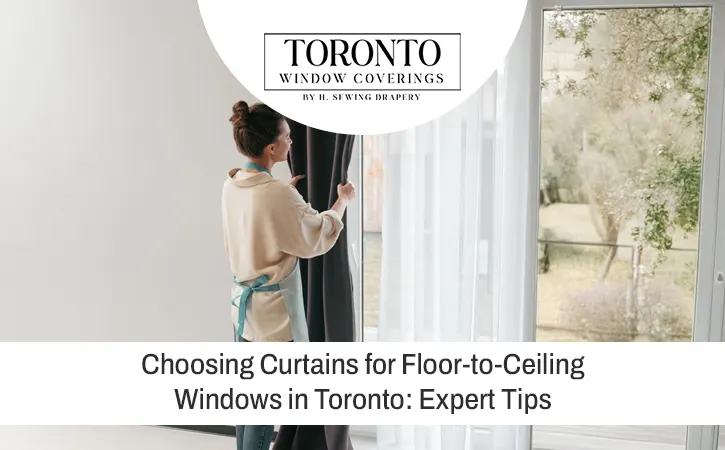
Choosing the best window treatments for tall windows comes from understanding what makes them different from other windows.
Tip 1: Know the Difference Between Light Filtering and Blackout
Curtains offer different functions. For privacy that still welcomes soft, diffused natural light, light-filtering curtains are the right choice. Conversely, blackout curtains are best for blocking almost all light, making them ideal for bedrooms or media rooms.
Light-filtering curtains are a popular choice in Toronto, especially because of the extended, bright summers. Homeowners frequently opt for these to temper strong afternoon sunlight while still maximizing natural daylight. Sheer and semi-sheer fabrics are highly effective for this purpose in spaces like living rooms and dining areas.
Blackout options are ideal for bedrooms, prioritizing sleep quality over visual appeal, and are also highly effective in north-facing rooms that receive minimal natural light.
Tip 2: Match Your Fabric to the Room’s Function
The choice of fabric is crucial, as it dictates a room’s mood and utility. For instance, heavy velvet brings a sense of warmth and formality to a living space. Conversely, linen imparts an airy, relaxed feeling, perfect for areas like a sunroom or kitchen. Furthermore, practical options like polyester blends are suitable for high-traffic rooms, offering easy maintenance and fade resistance.
Selecting quality curtains for the living room requires a balance of longevity and appearance. Given the length of Toronto’s winters and the temperature fluctuations near radiators, curtains must be durable. Fabrics that aren’t robust enough will quickly shrink, warp, or fade.
If you’re unsure, opt for a medium-weight woven fabric. It layers well, hangs cleanly, and works in almost every room.
Tip 3: Invest in Custom-Made Curtains for Unusual Windows
Standard curtain panels are designed for standard windows, but many homes feature non-standard-sized windows. If your panels are too short, the entire room will look unfinished. If they are too narrow, the window will feel cramped instead of properly dressed.
Custom-made curtains in Toronto offer the perfect solution, eliminating approximation entirely. You have full control, specifying the precise drop, width, heading style, and lining. For older Toronto homes, which often feature unusually tall or narrow windows, this is essential, not just a preference.
Achieving design consistency is simple with custom options, which let you match the fabric to your existing furniture or architectural details. This level of cohesion is unattainable with standard off-the-shelf panels.
Tip 4: Treat Bay Windows as a Design Feature, Not a Problem
Bay windows are among the most beautiful architectural elements in Toronto homes — and among the most mishandled. Most people either ignore the angles entirely or hang a flat curtain rod across the entire opening.
Window coverings for bay windows work best when they follow the window’s structure. The method chosen, whether angled rods, separate panels for each section, or a single, continuous curved track, significantly influences the overall look. The desired formality or relaxation of the room should guide this selection, as each option produces a distinct visual outcome.
For a cohesive look, use a single fabric across all sections of the bay. Using different fabrics in the same bay can create a chaotic appearance. A more polished approach is to maintain fabric consistency while varying the pleat styles.
Tip 5: Hang Curtains Higher and Wider Than the Window
This simple change is arguably the most impactful update a Toronto homeowner can make. By extending the curtain rod closer to the ceiling and wider than the window frame, you create the illusion of higher ceilings and larger windows. Conversely, hanging curtains just above the frame makes ceilings feel low, and windows appear smaller.
For an intentional and architectural window treatment, a helpful guideline is to mount the curtain rod 15–20 cm above the window frame and extend it 30–40 cm beyond the frame on both sides. This technique prevents the treatment from appearing to be a mere afterthought.
If your room has ceilings of nine feet or more, floor-to-ceiling curtain panels are almost always the ideal choice. They enhance the sense of grandeur without the need for any structural modifications.
Tip 6: Don’t Underestimate Lining
Lining is a fundamental, yet often unseen, component of high-quality curtains. It serves multiple purposes: adding structure and body, protecting the main fabric from damaging UV rays, and enhancing insulation. Especially in Toronto’s climate, incorporating a thermal lining can be key to significantly reducing heat loss through windows.
For a more luxurious and structured appearance, curtain lining is essential. Unlined curtains often look flat and inexpensive, regardless of the fabric quality. Blackout lining provides necessary weight and structure, allowing the panels to hang more neatly.
For the opulent, padded look characteristic of high-end window treatments and designer curtains, consider interlining—a layer of batting placed between the main fabric and the lining.
For any room you care about, always line your curtains.
Tip 7: Consider Professional Measuring Before Ordering
Measuring can be tricky, even for seasoned decorators. Complications often arise from features like bay windows, uneven ceilings, or intricate architectural mouldings, leading to incorrect initial measurements.
When investing in custom curtains, professional measuring is crucial. Many Toronto window treatment experts include this service in their consultation. This small cost is a worthwhile investment, eliminating the risk and expense of reordering ill-fitting panels and ensuring your curtains are ready to hang perfectly upon arrival.
If you’re ordering online, double-check every measurement twice, and always measure the drop from where the rod will sit, not from the top of the window frame.
Tip 8: Think About Hardware as Part of the Design
Curtain rods, rings, and finials are not afterthoughts. They are visible components of these window treatments and should be chosen with the same care as the fabric itself.
Brushed brass hardware suits warm, layered interiors. Matte black works well in modern or industrial spaces. Polished chrome reads as clean and contemporary. Mismatched hardware pulls visual attention for the wrong reason.
Designer curtains often owe much of their elegance to the hardware supporting them. A well-chosen rod can elevate an ordinary panel into something that looks genuinely considered.
Tip 9: Layer Window Coverings for Flexibility
In high-end interior design, layering window treatments is a common and practical approach, not merely a stylistic choice. By combining sheer, light-filtering curtains with heavier drapes, you gain complete flexibility in managing both privacy and natural light throughout the day.
Layered window coverings offer superior insulation compared to single-panel coverings, particularly during Canadian winters. Pairing drapes with shutters or blinds creates an effective additional thermal barrier. Furthermore, for west-facing rooms that receive strong late-afternoon sunlight, the combination of sheers and drapes allows light to filter without complete blockage.
Layering also creates depth and visual texture—two things that make rooms feel finished rather than furnished.
Tip 10: Prioritize Quality Over Quantity
Resisting the urge to quickly cover all windows is key. Instead of using five average curtains, focus on investing in one high-quality, well-made curtain for a focal point. Curtains for the living room, especially, benefit greatly from this focus on quality.
Don’t settle for cheap curtains that will fade, sag, or pill. Curtains with quality construction, especially those that are lined and properly maintained, will hold their structure for years. In a city with accessible, quality tradespeople and textile specialists, you have no reason to compromise on quality.
Buy less, buy better—and your windows will look intentional rather than improvised.
Choosing the right covering for floor-to-ceiling windows requires patience and expert advice. The correct choice enhances the room seamlessly. Whether you prefer sheers, layered drapes, or a motorized system, the key is working with professionals who measure precisely, understand your routine, and recommend genuine solutions. Toronto Window Coverings’ curtain specialists provide grounded expertise to ensure your results look right, function beautifully, and last for years.
Frequently Asked Questions
Q: Can I use regular curtains on floor-to-ceiling windows?
A: For floor-to-ceiling windows, standard curtains are typically too short. Opting for custom-made panels, precisely tailored to your window’s height, ensures proper coverage and a polished aesthetic.
Q: How do I get privacy with floor-to-ceiling windows without blocking all the light?
A: For optimal light and daytime privacy, consider sheer panels. By layering these with opaque panels, you gain flexibility and ensure complete privacy at night.
Q: Are motorized curtains worth it for tall windows?
A: Motorized curtains offer easy control of large panels on high windows and remove the risk of cord hazards, particularly in households with children.
Q: Do floor-to-ceiling curtains help with energy efficiency in Toronto?
A: Custom curtains are beneficial for year-round temperature regulation. By minimizing heat loss during winter and heat gain in summer, they help maintain a comfortable indoor climate while simultaneously reducing energy costs.
- Categories:
- Curtains